Addison Chambers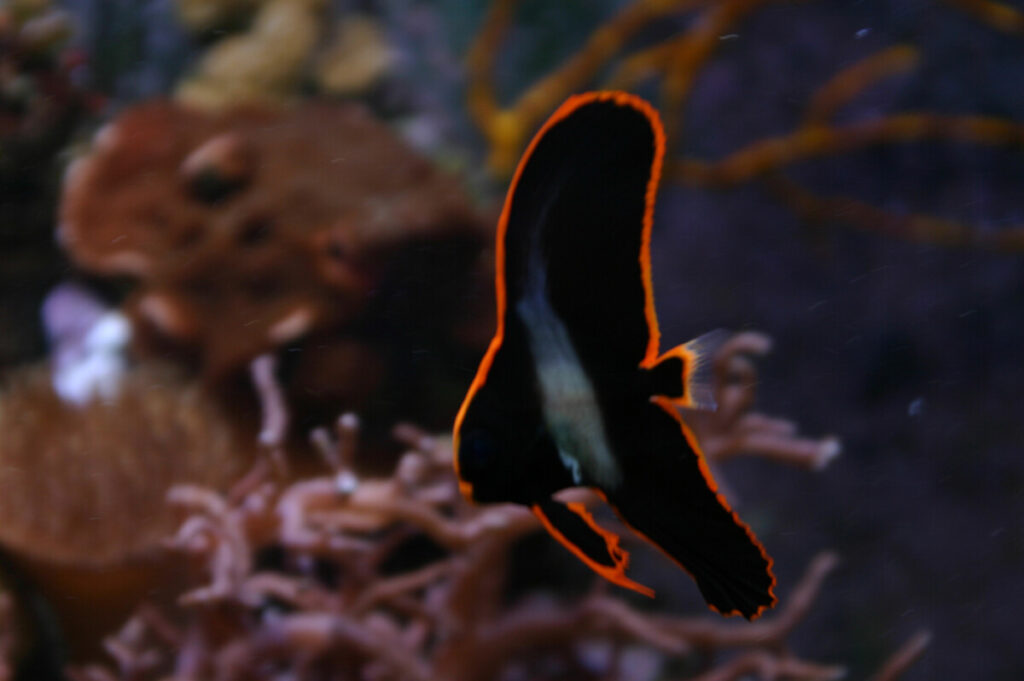
The ocean teems with incredible survival strategies, from camouflage to rapid escape techniques. Among these, mimicry stands out as one of the most fascinating evolutionary adaptations. In the coral-rich regions of the Indo-Pacific, one species has mastered the art of deception, the juvenile pinnate batfish (Platax pinnatus). Unlike many reef fish that rely on hiding or speed, the young pinnate batfish tricks predators into thinking it’s something else entirely. With its ghostly, flatworm-like appearance and graceful movements, this species is a living illusion. In this article, we explore how mimicry plays a central role in its survival and how divers at places like Lembeh Resort are frequently mesmerised by this behaviour in the wild.
What Is Mimicry in Marine Animals
Mimicry in biology is a strategy in which one species evolves to resemble another to gain a survival advantage. In the ocean, mimicry can mean the difference between life and death. Marine species often use this tactic to confuse predators, blend into their environment, or even trick prey. There are two primary types of mimicry:
- Batesian mimicry occurs when a harmless species mimics a harmful or toxic one.
- Müllerian mimicry happens when two harmful species evolve to look similar, reinforcing the warning signal to predators.
In marine ecosystems, mimicry is commonly observed in species such as the mimic octopus, which imitates venomous sea snakes and lionfish, and in juvenile wrasses that pretend to be cleaner fish. This strategy not only enhances survival but also demonstrates the complexity of evolutionary development in marine life.
The Pinnate Batfish as a Master Mimic
Juvenile pinnate batfish are among the most captivating fish encountered by underwater photographers and divers. Their sleek, all-black bodies are bordered in a fiery orange, making them instantly distinguishable from other reef inhabitants. But their most striking feature is their undulating movement, which doesn’t resemble a typical fish. Instead, their behaviour and appearance closely mimic that of toxic polyclad flatworms.
This isn’t coincidental. The batfish’s mimicry serves a critical function: it deters predators that have learned to associate flatworm visual cues with a negative experience, such as toxicity or foul taste. The visual deception is so effective that divers, even those with years of experience, often mistake the batfish for a worm until it swims away. This mimicry is frequently observed in dive hotspots such as Lembeh Resort, where calm muck-diving conditions allow close observation of rare juvenile behaviour.
Read also: Best Diving Spots to See Pinnate Batfish in Southeast Asia
Why Mimic a Toxic Flatworm
The logic behind this mimicry is rooted in predator psychology. Toxic flatworms produce chemicals that make them distasteful or even harmful to predators. As a result, many reef predators learn over time to avoid these creatures. By resembling a flatworm in both colour and movement, the pinnate batfish capitalises on this learned avoidance behaviour. Essentially, it “borrows” the flatworm’s reputation without possessing any of its defences.
This form of deception is a textbook example of Batesian mimicry, in which the mimic gains protection simply by resembling a more dangerous organism. For the juvenile batfish, this strategy is a brilliant way to reduce the risk of being eaten during its most vulnerable life stage.
Effectiveness of This Mimicry Strategy
Reports from marine biologists and recreational divers alike confirm the effectiveness of the pinnate batfish’s mimicry. Predators seem to keep their distance, possibly due to past encounters with genuine flatworms. This aversion can persist long enough for the batfish to reach a size at which mimicry is no longer necessary.
However, this fascinating disguise is short-lived. As the fish matures, it undergoes a transformation that includes a complete change in colour and body shape. The intense black and orange fade away, replaced by a more traditional silver and grey colouration. Despite this, during its juvenile stage, the mimicry is considered highly successful, dramatically increasing the fish’s chances of survival in the predator-rich environments of coral reefs.
What Happens After the Juvenile Stage
As pinnate batfish transition into adulthood, their bodies grow broader and taller, and their colouration becomes more muted. The orange trim disappears, and their once flatworm-like silhouette transforms into a more disk-shaped profile. With this transformation, they lose their ability and their need to mimic toxic flatworms.
Instead of mimicry, adult batfish rely on other strategies for protection. These include:
- Swimming in more profound or more complex reef structures to avoid open water predators.
- They use their size to deter smaller predatory species.
- Travelling in small groups for added security.
While adult batfish are still beautiful and graceful swimmers, they no longer rely on illusion to survive.
Evolutionary Advantage of Mimicry in Pinnate Batfish
The mimicry seen in juvenile pinnate batfish is an excellent example of natural selection. Over generations, those individuals who more closely resembled toxic flatworms likely had higher survival rates and thus more opportunities to pass on their genes. This gradual process shaped the modern juvenile’s highly specific appearance and behaviour.
This temporary mimicry, lasting only through the early life stage, shows that even short-term adaptations can provide substantial evolutionary benefits. It also highlights how species can develop specialised traits that serve a precise function during one phase of life before being discarded in favour of other survival mechanisms later.
Conclusion
The juvenile pinnate batfish is not just a pretty face on the reef, it’s a tactical survivalist. Through an extraordinary mimicry of toxic flatworms, it avoids becoming an easy meal during the most dangerous phase of its life. As it grows, this survival strategy is shed, making way for new defences. But during those early weeks and months, the disguise can mean the difference between life and death. Encounters with this elusive fish, particularly in biodiverse regions like North Sulawesi, remind us of the intricate and often ingenious ways marine species adapt to their environment.