Addison Chambers
Skincare ingredients not to mix are usually powerful active ingredients that can cause excessive dryness, burning, peeling, or redness when layered carelessly. The issue is rarely that two ingredients become universally dangerous when combined. More often than not, several potentially irritating products overwhelm the skin. Product strength, formulation, frequency, skin type, and existing medical treatments all influence how a combination performs.
What Is the Short Answer?
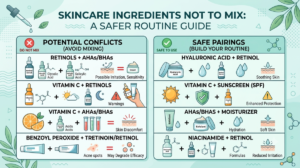
Be cautious about layering retinoids with exfoliating acids, benzoyl peroxide with additional exfoliants, or several acid products in one routine. Avoid using two versions of the same strong active unless a dermatologist recommends it.
Introduce products gradually, moisturise consistently, and use broad-spectrum sunscreen during the day. Prescription products should always be applied according to the instructions provided by a qualified medical professional.
Why Can Active Skincare Ingredients Cause Irritation?
Retinoids, benzoyl peroxide, alpha-hydroxy acids, and beta-hydroxy acids may help address acne, uneven texture, pigmentation, or signs of ageing. However, they may also cause dryness, sensitivity and peeling, particularly when introduced too quickly.
The American Academy of Dermatology warns that exfoliating while using retinol, prescription retinoids or benzoyl peroxide may worsen dryness and irritation. Using multiple products with similar effects can create cumulative stress on the skin.
This is why skincare ingredients that should not be mixed should be understood as combinations that may be poorly tolerated when applied together, rather than as a completely inflexible list. A professionally formulated combination product may behave differently from two separate high-strength serums layered at home.
Should You Mix Retinoids With AHA or BHA Exfoliants?
For many people, applying retinol, tretinoin, adapalene, or another retinoid alongside glycolic, lactic, or salicylic acid can be too irritating. Both categories may contribute to dryness and peeling.
Combining them immediately can lead to stinging, redness, flaking or skin that feels unusually tight. Retinoids themselves can produce irritation, especially when a person begins using them or applies them too frequently.
A gentler approach is to apply the retinoid on selected nights and use the exfoliating acid on different nights. Beginners may need several days between treatments. Follow with a simple moisturiser and reduce the frequency if irritation appears.
People with eczema, rosacea, very dry skin or an existing prescription routine should speak with a dermatologist before introducing exfoliating acids.
Can Benzoyl Peroxide Be Used With Exfoliating Acids?
Benzoyl peroxide is commonly used in acne care because it reduces acne-causing bacteria. It may also help reduce blackheads and whiteheads, but dryness and irritation are common concerns when too much is applied.
Adding a strong AHA, BHA, peeling solution, abrasive scrub or alcohol-heavy toner during the same session can create a cumulative irritation effect. Dermatologists specifically caution that exfoliating while using benzoyl peroxide may worsen dry skin.
Instead of stacking treatments, select the active that best matches your main concern. Benzoyl peroxide may be prioritized for inflamed acne, while salicylic acid may be introduced on separate days to address clogged pores.
Are Benzoyl Peroxide and Retinoids Always Incompatible?
No. This is one of the most misunderstood combinations of skincare ingredients.
Dermatologists may prescribe treatments that combine benzoyl peroxide with a retinoid. Approved products containing tretinoin and benzoyl peroxide also exist, demonstrating that the ingredients are not automatically incompatible when properly formulated.
However, separately layering an over-the-counter benzoyl peroxide product with retinol or a prescription retinoid can still cause significant dryness or irritation. The exact ingredient, concentration and product formulation matter.
Follow the product label or your prescriber’s directions rather than assuming that every benzoyl peroxide and retinoid product can be used the same way. Applying one in the morning and the other at night, or alternating days, may be easier to tolerate when a professional approves both products.
Should You Use More Than One Exfoliating Acid?
Using a glycolic acid toner, a salicylic acid serum, an exfoliating mask, and a facial scrub in a single routine is rarely necessary. Multiple exfoliants can result in burning, tightness, flaking and increased sensitivity.
One practical rule for skincare ingredients not to mix is to avoid unnecessarily duplicating the same function. Read complete ingredient lists because exfoliating acids may be found in cleansers, toners, serums, masks and spot treatments.
One carefully selected exfoliant used at an appropriate frequency is generally easier to manage than several overlapping products.
Can Vitamin C and Retinol Be Used Together?
Vitamin C and retinol are frequently described online as ingredients that should never be combined, but this statement is too absolute. Research has evaluated formulations containing both retinol and vitamin C, showing that professionally developed products may successfully include them together.
However, sensitive skin may find both active ingredients too strong when applied in the same routine. Separating them can also make it easier to identify which product is causing redness, dryness or stinging.
A practical schedule is to use vitamin C in the morning before sunscreen and apply retinol at night. Retinol should initially be introduced only a few evenings per week, particularly for new users.
What About Retinoids With Other Acne Treatments?
Retinoids may be used alongside benzoyl peroxide, salicylic acid, sulphur, medicated cleansers or prescription acne treatments as part of a professionally developed plan.
Problems often arise when several products are added independently without considering cumulative irritation. Consumer instructions for prescription tretinoin advise patients to discuss other acne medicines with their doctor because combined use may cause additional redness or peeling.
Avoid building an additional routine filled with strong active ingredients when you already use prescription acne medication.
How Can You Build a Safer Skincare Routine?
Begin with three essentials:
- A gentle cleanser
- A moisturizer suitable for your skin type
- A broad-spectrum sunscreen with SPF 30 or higher
Dermatologists recommend keeping routines relatively simple because using too many products can irritate the skin. Daily sun protection is especially important when using treatments that may increase sensitivity.
Add only one treatment product at a time. Patch-test it, follow the label and allow enough time to understand how your skin responds. Dermatologists recommend testing new skincare products on a small area before applying them more widely.
A simple schedule might include vitamin C in the morning, retinol on two non-consecutive evenings and an exfoliating acid on a different evening. The remaining nights can focus on cleansing and moisturising.
The safest way to interpret skincare ingredients that do not mix is to separate potentially irritating actives until you understand how your skin tolerates each one.
What Are the Signs That You Are Using Too Many Actives?
Possible signs of irritation include:
- Persistent burning or stinging
- Unusual redness
- Itching or swelling
- Painful tightness
- Cracking or excessive peeling
- Increased sensitivity to ordinary products
Stop using the newest or most irritating products and return to a simple cleanser, moisturiser, and sunscreen routine. Seek medical advice when the reaction is severe, affects the eyes, produces blistering or continues after the suspected products have been stopped.
Build a Routine Without Overloading Your Skin
The best skincare routine is not necessarily the one with the most active ingredients. It is the routine your skin can tolerate consistently.
Understand what each product does, avoid unnecessary duplication, separate potentially irritating treatments and protect your skin from the sun. When prescription products, persistent acne or severe irritation are involved, professional guidance is safer than experimenting with increasingly complicated routines.
Frequently Asked Questions
Not necessarily. A brief, mild sensation may occur with certain products, but persistent burning, pain, swelling or pronounced redness suggests irritation rather than effectiveness.
There is no universal waiting period. Introduce one product first and use it long enough to understand how your skin responds before adding another. People with sensitive skin should progress particularly slowly.
Niacinamide appears in many multi-ingredient products and is commonly used alongside other actives. However, individual tolerance and the complete formulation still matter. Introduce the product gradually rather than evaluating it solely by one ingredient.
Seek professional advice when acne is painful or causing scars, pigmentation continues to worsen, the skin remains inflamed, or you already use prescription treatments.
People who are pregnant or planning a pregnancy should also discuss their routines with a medical professional. Dermatologists recommend avoiding retinoids during pregnancy.